
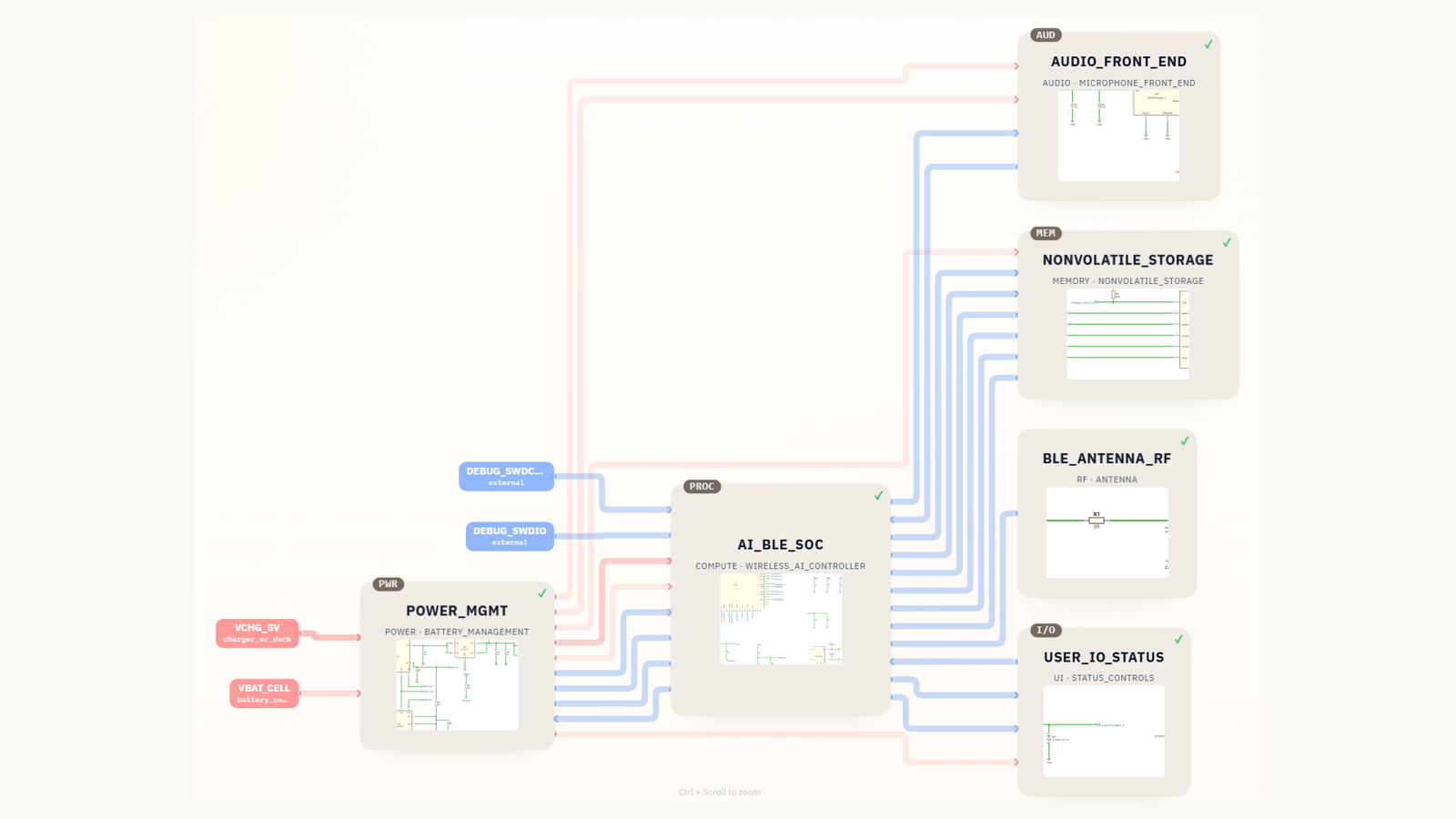
SpeedUp turned a short product prompt into a reviewable BLE microphone schematic and KiCad project for a tiny magnetic AI label microphone. The generated package includes a block diagram, KiCad schematic sheets, symbol and footprint files, a BOM preview, and a downloadable project ZIP.
This is a first engineering draft for review, not a production-ready reference design. It is meant to help a hardware team inspect the architecture, component choices, power path, audio capture path, BLE sync path, local storage, and manufacturing assumptions.
Project Summary
| Field | Details |
|---|---|
| Project | Tiny magnetic AI label microphone |
| Input | Natural-language product prompt |
| Output | Reviewable KiCad schematic project |
| Key modules | BLE SoC, microphone front end, local storage, battery power, antenna, user I/O |
| Included files | KiCad project, schematic sheets, symbol libraries, footprint libraries, BOM files, downloadable ZIP |
| Status | First engineering draft for review |
The Prompt
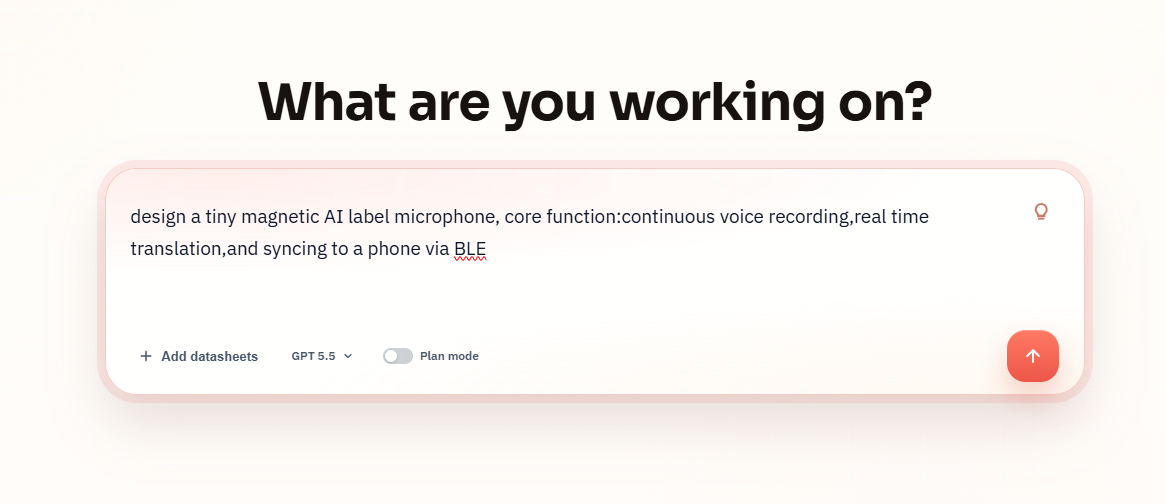
The project starts with this plain-language device request:
design a tiny magnetic AI label microphone, core function:continuous voice recording,real time transtion,and syncing to a phone via BLE
What SpeedUp Generated
From that prompt, SpeedUp generated:
- A block diagram for the product architecture
- A top-level KiCad schematic
- Module schematics for compute, audio, storage, RF, power, and user I/O
- Symbol and footprint libraries
- A BOM preview with 50 line items and 87 placed quantities
- A downloadable KiCad project package
Want to create a BLE audio device?
Describe your own BLE audio recorder requirements and create a free account to start a reviewable engineering draft.
Project Architecture
The generated design is split into reviewable modules:
POWER_MGMT: charging input, battery path, system rail switching, 1.8 V regulation, and fuel-gauge supportAI_BLE_SOC: BLE controller, clocks, debug, storage interface, audio data, RF feed, and status I/OAUDIO_FRONT_END: microphone input and PDM audio pathNONVOLATILE_STORAGE: local QSPI storage for saved audio or bufferingBLE_ANTENNA_RF: BLE RF feed and chip antenna areaUSER_IO_STATUS: wake button, recording LED, and status LED signals
This structure matters because the output is not just a concept image. The project is organized in a way an engineer can open, inspect, and continue.
KiCad Schematic Output
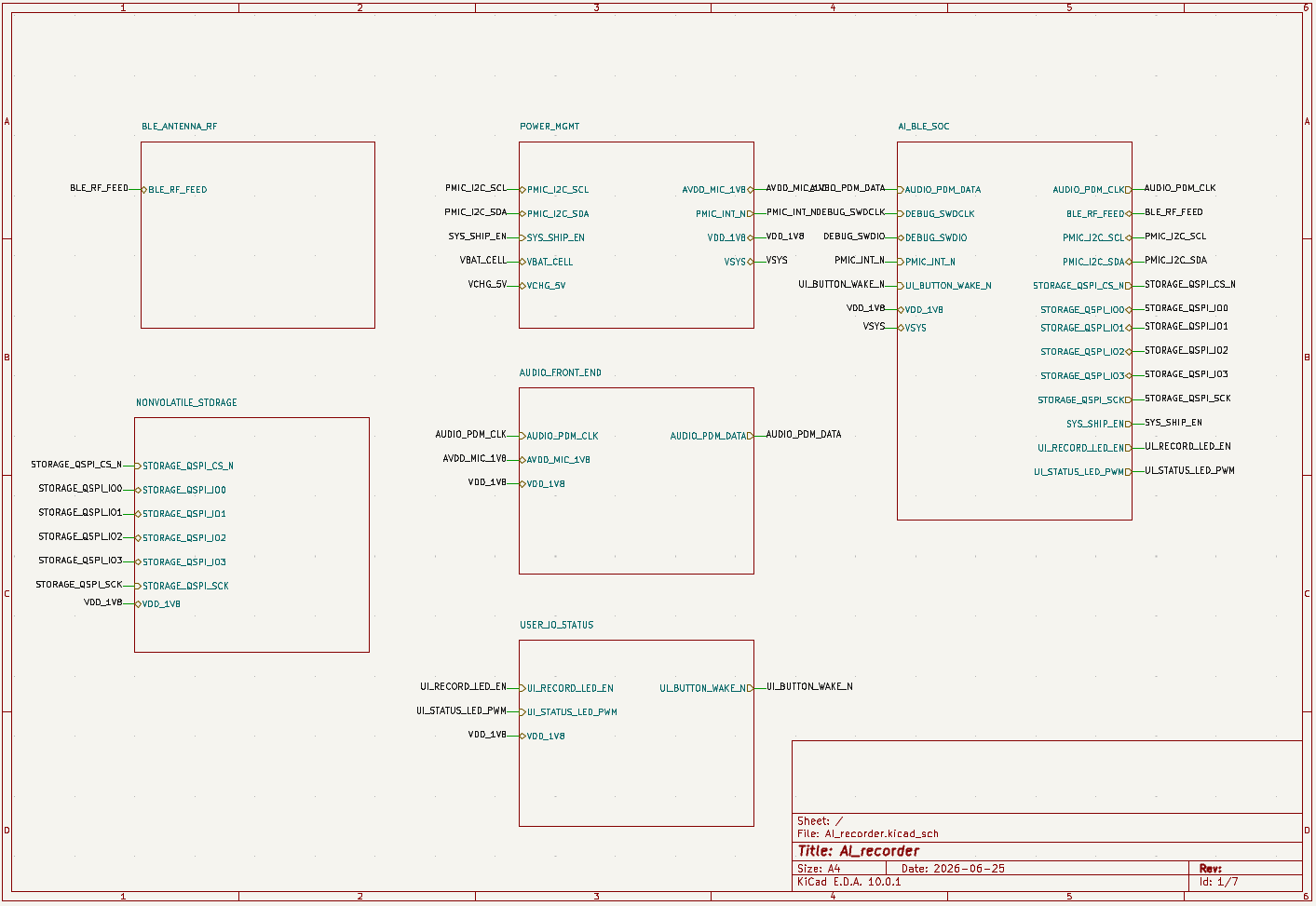
The downloadable package includes AI_recorder.kicad_pro, AI_recorder.kicad_sch, module-level schematic sheets, symbol libraries, footprint libraries, and BOM files. These files make the result useful as an engineering starting point rather than a static mockup.
Power and Battery Management
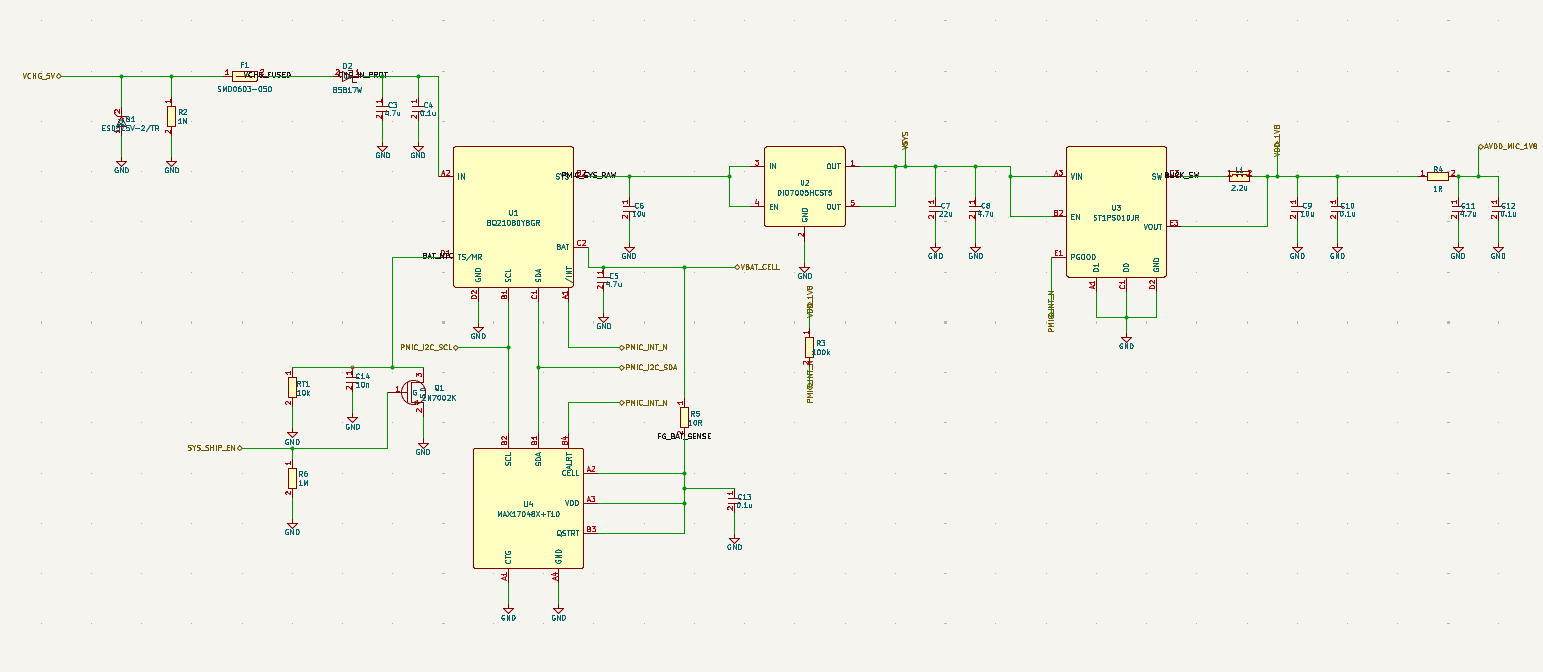
The power section includes USB or dock charging input, a single-cell Li-ion charger, a load switch, a 1.8 V regulator, and a fuel gauge. Representative parts include BQ21080YBGR, DIO7005HCST5, ST1PS01DJR, and MAX17048X+T10.
Before production, this section needs review for charge limits, thermal behavior, battery capacity, ship mode, quiescent current, rail sequencing, and the mechanical constraints of a magnetic wearable or label-style device.
Compute, BLE, Audio, and Storage
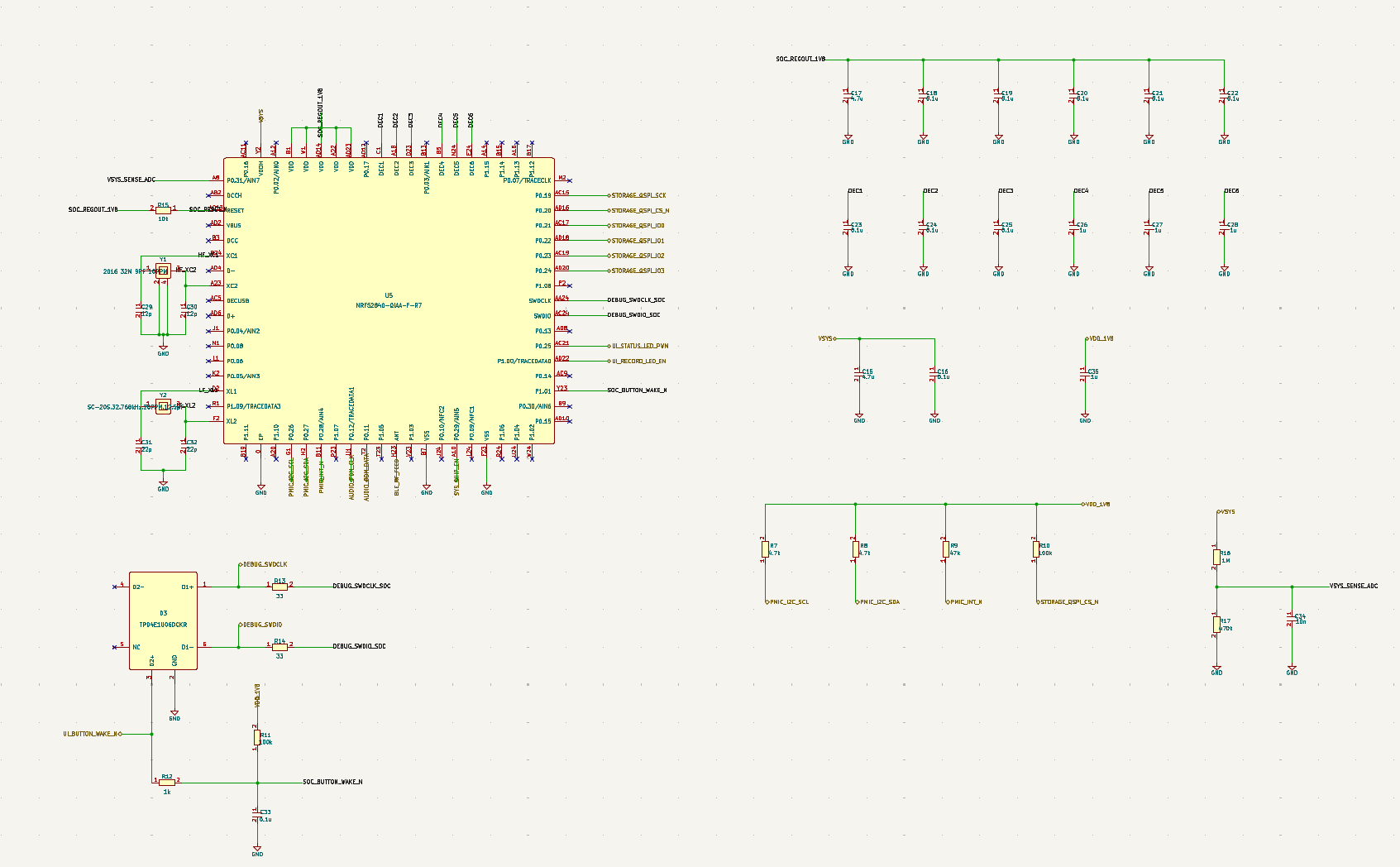
The compute module uses an NRF52840-QIAA-F-R7 as the BLE-capable controller. The generated design also includes a PDM microphone path, QSPI storage signals, debug connections, crystal references, and status outputs. Representative BOM parts include SPH9855LM4H-C for audio capture and GD5F1GQ5REYIGR for local nonvolatile storage.
The schematic supports audio capture, local storage, BLE communication, and device-status control. Real-time translation still depends on firmware, phone-side software, AI processing, privacy design, and latency targets.
BOM Preview
The generated BOM includes 50 line items and 87 total placed quantities. It gives engineers a starting point for component review, footprint validation, availability checks, substitutions, lifecycle risk, and early cost estimation.
This should not be treated as a final production BOM. Every component still needs review against electrical requirements, mechanical constraints, compliance needs, sourcing risk, and firmware behavior.
What Still Needs Human Review
Before production, the design should be reviewed for:
- Audio noise, microphone placement, PDM clocking, and acoustic constraints
- Battery capacity, charging limits, thermal behavior, and standby current
- BLE antenna placement, RF matching, enclosure effects, and magnetic mounting effects
- Storage endurance, write patterns, data retention, and file management
- Secure boot, signed updates, debug locking, privacy, and phone-app data handling
- Component availability, package choices, footprints, and manufacturing test flow
Related SpeedUp Projects and Guides
- Read the KiCad schematic generator workflow guide to compare this BLE microphone project with a broader prompt-to-KiCad process.
- Use the schematic review checklist for AI-generated KiCad projects before using generated audio, BLE, power, or storage circuits for layout.
- Compare it with the TWS earbuds schematic and charging case project for another compact audio hardware example.
FAQ
Is this design production ready?
No. This is a first engineering draft intended for review, iteration, and validation before production.
Can this project be opened in KiCad?
Yes. The package includes KiCad project files, schematic sheets, symbol libraries, footprint files, and BOM files.
Does the schematic implement real-time translation?
The schematic supports audio capture, storage, BLE communication, and power management. Real-time translation depends on firmware, a phone app or cloud pipeline, model behavior, privacy requirements, and latency targets.
Can I generate a similar project from my own prompt?
Yes. SpeedUp is designed to turn natural-language device ideas into structured engineering artifacts that can be reviewed, modified, and refined.
Download the KiCad Project
Use this magnetic AI microphone KiCad ZIP as a review starting point for the generated schematic project. The package includes the KiCad project file, top-level schematic, module sheets, symbol libraries, footprint libraries, and BOM files; review component availability, footprints, RF behavior, battery and charging assumptions, and firmware before treating it as a production-ready handoff.
Create Your Own BLE Audio Project
Turn your own BLE audio recorder brief into reviewable engineering artifacts.
Use SpeedUp to generate structured schematic sheets and an editable KiCad project for engineering review. Create a free account to begin.
Comments
No comments yet.
Leave a Reply